What DAC8 requires. And what it means for you.
You are affected if you buy, sell or keep crypto-assets through a provider such as an exchange, broker or app. Anyone who only uses self-custody and never uses a provider is not reported.
What goes to the tax office. What stays with the provider.
Under Austria’s Crypto-Asset Reporting Obligations Act, the provider reports to the tax office every year, starting with 2026. It keeps the details, most of them already under anti-money-laundering rules.
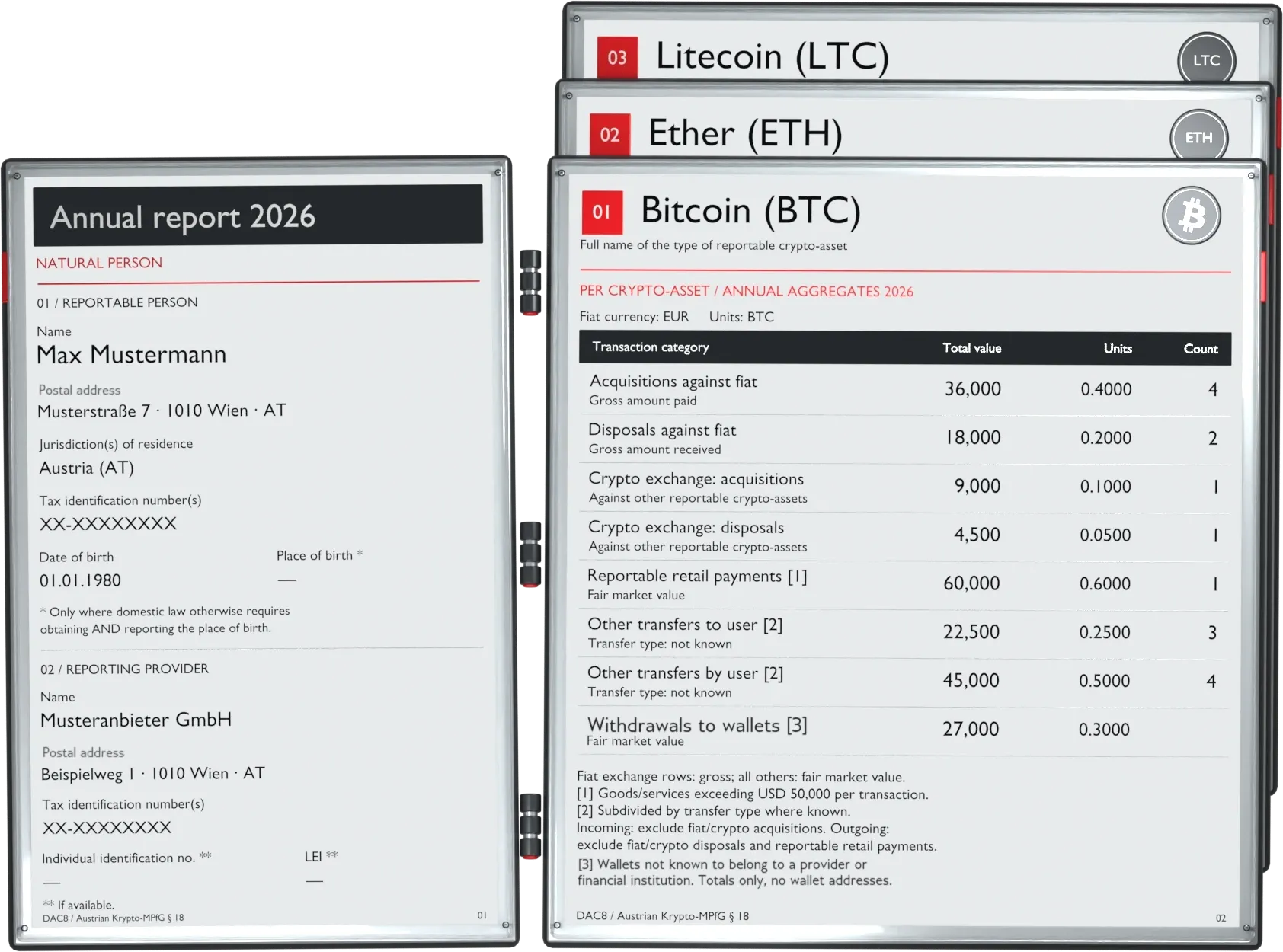
Goes to the tax office
- Name, postal address and date of birth
- Tax residence and tax identification number
- For each crypto-asset, the annual totals for purchases, sales, exchanges and transfers: euro value, units and, for most categories, the number of transactions
- Transfers to wallets with no known provider, usually including your own: as a total, without wallet addresses
- Activities that often have no tax consequences, such as crypto-to-crypto exchanges
The provider must prepare this reporting data for all customers, even those who are not ultimately reported. Section 20(1) Krypto-MPfG
Stays with the provider
Section 21 FM-GwG, Regulation (EU) 2023/1113
- Your ID and the records of your identification
- Wallet addresses, including those of your own wallet
- Individual transactions with time and amount, and for transfers, the sender and recipient
- Your balance
For DAC8, the provider adds your tax identification number and tax residence to these records.
Who keeps your data, and for how long
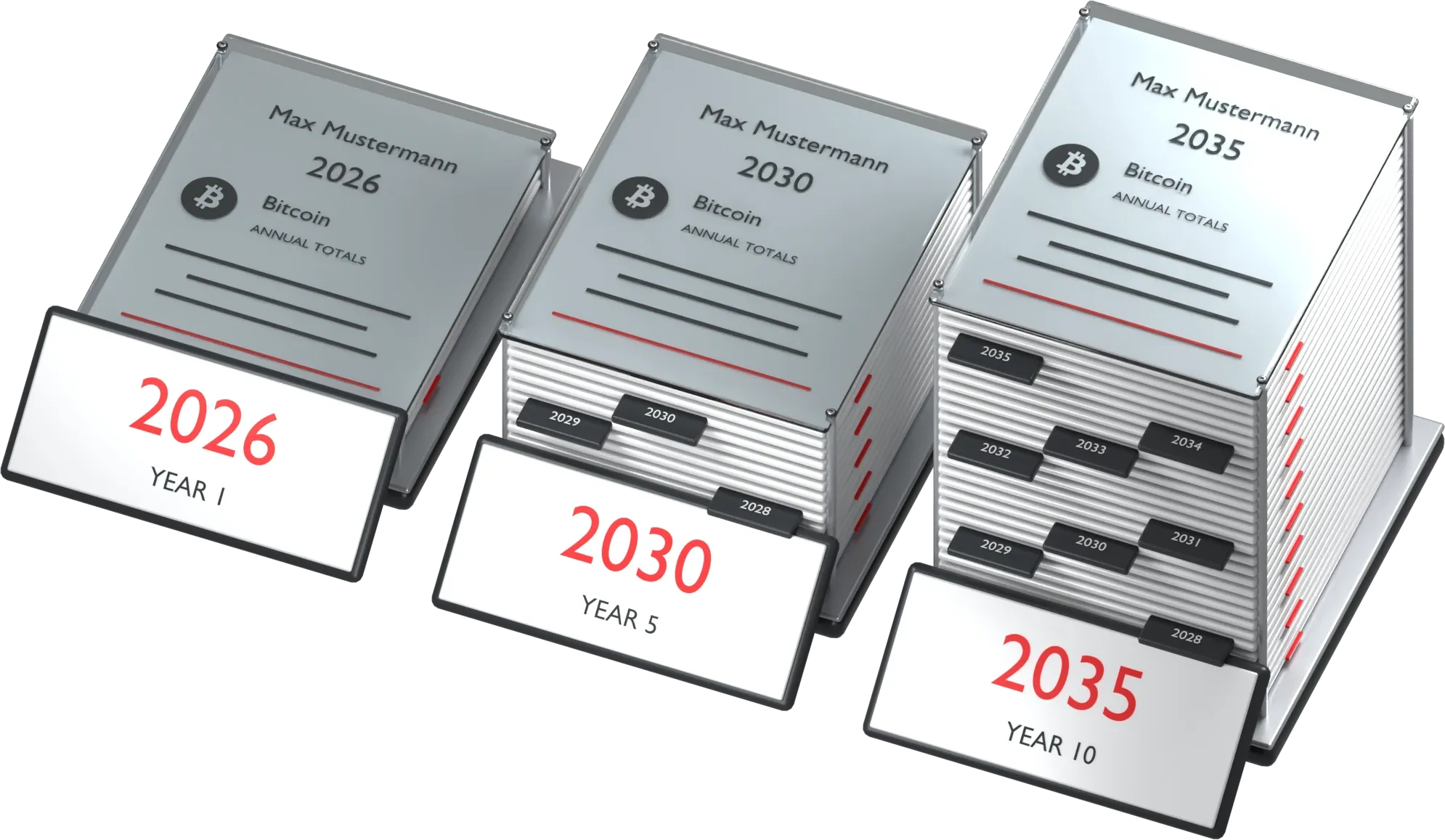
Every year adds another report, and the longest period only starts when you close your account.
| Who | What | How long |
|---|---|---|
| Your provider | Your ID, wallet addresses and individual transactions | currently up to ten years after the customer relationship ends Section 21 FM-GwG |
| Your provider | Each annual report | ten years after the reporting year, then it is deleted Section 20(4) Krypto-MPfG |
| Tax authority of another EU country, such as Germany | The annual report, if you are tax-resident there | at least five years; the directive sets no maximum Article 22(3) DAC |
How the reporting works
DAC8 is an EU directive extending the automatic exchange of tax information between EU countries to crypto-assets. Austria implements it through the Crypto-Asset Reporting Obligations Act (Krypto-MPfG), which has applied since 1 January 2026.
Directive (EU) 2023/2226, Federal Law Gazette I No. 96/2025
- 2026 Your provider records the first reporting year and prepares the reporting data for all customers. Section 20(1) Krypto-MPfG
- By 31 July 2027 It reports 2026 to the Austrian tax office. Section 19(2) Krypto-MPfG
- By 30 September 2027 If you live in Germany or another EU country, Austria passes the report on to it. Section 21 Krypto-MPfG
- Every year The same happens again for each following year.
Questions and answers
Will my wallet address be reported?
No, wallet addresses are not in the annual report. But the value and units transferred to wallet addresses not known to belong to another provider are reported, as a total. This usually includes your own wallet. The wallet address and its link to you nevertheless remain stored with the provider under anti-money-laundering rules.
Can the report reveal my wealth?
Not directly. It contains annual totals, not current balances or total wealth. Your provider does know your balance, though, and over the years the reports show how much you move. Anyone who combines them with the bank account register and blockchain analysis or, after a breach, with provider records can build a detailed picture of a person’s assets.
What about purchases and sales before 2026?
They will not be reported retroactively. The first reporting period starts on 1 January 2026. A retroactive obligation would require a new law; neither DAC9 nor the current proposal to recast the directive provides for this. The provider still holds older transactions: since 2020, anti-money-laundering rules have required it to keep them, currently for up to ten years after the customer relationship ends.
I live in Germany. Who receives my data?
With a provider that reports in Austria, your annual report goes to the Austrian tax office first, and Austria passes it on to Germany by 30 September, because you are tax-resident there. Providers in Germany or another EU country report there; the data also ends up with the German tax authorities. Whatever a country receives through the exchange it must keep for at least five years under the directive, which sets no fixed maximum. Your ID, wallet addresses and individual transactions stay with the provider.
What does the complaint change for me?
Nothing yet: data collection continues during the proceedings. We are convinced that collecting data on every customer violates fundamental rights. The Data Protection Authority is bound by the law and may not review whether it is compatible with constitutional or EU law. That question therefore lies with the courts, as does whether the case goes to the Court of Justice of the European Union. How long this will take, and how individuals can take part, we are still working out.
How do I recognise phishing that uses the reporting duty?
Fake FinanzOnline messages are already circulating in Austria, asking about your holdings on the pretext of new crypto tax rules. The tax office does not ask about them by email or text message. No legitimate sender asks you to connect a wallet or enter your recovery phrase, the words that restore a wallet. Your provider reports the DAC8 data itself. Be discreet about your holdings, including with acquaintances and on social media. Watchlist Internet warning (German)
Do DAC9 and DAC10 mean more crypto surveillance?
Not automatically. DAC9 concerns minimum taxation of large corporate groups, not individual crypto users. The recast proposed in June 2026, often called DAC10, is not yet law and retains the existing crypto reporting fields.
Terms
Words with a dotted underline explain themselves when you tap them. Here are all of them, A to Z.
- Annual report What the provider sends the tax authority every year under DAC8: name, postal address, tax residence, tax identification number, date of birth and annual totals per crypto-asset. Wallet addresses and individual transactions are not in it.
- DAC8 A 2023 amendment to the EU directive on administrative cooperation in taxation (2011/16/EU). It extends the automatic exchange of tax data to crypto-assets.
- FM-GwG Austria’s Financial Markets Anti-Money Laundering Act. It requires the identity check and the retention of identification and transaction records, currently until ten years after the relationship ends.
- Honeypot A data store that gathers so much of value in one place that it attracts attackers.
- Krypto-MPfG The Crypto-Asset Reporting Obligations Act, Austria’s implementation of DAC8, in force since 1 January 2026. It also requires providers to prepare reporting data for all customers.
- KYC Know Your Customer: the identity check when you open an account with a provider, for example with your ID and a selfie. Anti-money-laundering rules require it, and the provider currently keeps the records until ten years after the relationship ends.
- Provider In law, a crypto-asset service provider: exchanges, brokers and apps where you buy, sell or keep crypto-assets, including banks that offer crypto. They report under DAC8.
- Recovery phrase Usually 12 or 24 words that restore a wallet. Whoever knows them can move the bitcoin. Never share your recovery phrase.
- Self-custody You hold the keys to your bitcoin yourself, for example on a hardware wallet, instead of leaving them with a provider. As with cash at home, nobody has to approve a transfer.
- Travel rule The EU transfer of funds regulation: for every crypto transfer, the provider records details of the sender and recipient, including when you transfer to your own wallet.
- Wallet An app or device that manages the keys to your crypto-assets. If you leave them with a provider, it holds the keys for you.
- Wallet address A string such as bc1q… that bitcoin can be sent to, much like an account number. Payments to an address are public on the blockchain. Not to be confused with your home address.
Sources
The dossier rests on legislation, EU law, court rulings and reports. Research last updated: 30 September 2026. Sources on the development from 1977 to the recast are in the history of the DAC.
Show all 37 sources Hide sources
Austrian law
- Crypto-Asset Reporting Obligations Act, Federal Law Gazette I No. 96/2025
- Section 18 Krypto-MPfG: reporting fields
- Section 20 Krypto-MPfG: processing for all customers and deletion
- Section 39 Krypto-MPfG: documentation retention
- Section 5 GMSG: five years for bank-account data
- Section 24 DSG: complaints and deadlines
- Section 21 FM-GwG: retention of identification and transaction records
EU law
- Directive (EU) 2023/2226 (DAC8)
- Regulation (EU) 2023/1113: originator and beneficiary information for crypto-asset transfers
- Directive (EU) 2024/1640, Article 16: account registries and their EU-wide interconnection
- MiCA, Article 68(9): retention periods
- Regulation (EU) 2025/1140: provider records linked to blockchain data
- European Commission impact assessment on DAC8, SWD(2022) 401
- Directive (EU) 2025/872 (DAC9)
- Commission proposal COM(2026) 308: recast of the directive
- European Commission: overview of the DAC framework
- EU feasibility study on a European asset registry
Courts
Payment profiles
Data breaches, attacks and fraud
- Watchlist Internet: phishing in FinanzOnline’s name asks for crypto holdings
- Watchlist Internet: FinanzOnline text messages ask in bulk about crypto accounts
- Abramova and Böhme (University of Innsbruck, 2023): the aftermath of the Ledger data breach
- Waltio: security incident at the crypto tax service
- French tax administration: unauthorised access to the FICOBA account register, February 2026
- French Economy Ministry: data theft from the tax system, August 2026
- Austrian Finance Ministry disciplinary board: thousands of private queries in the tax system
- French Interior Ministry: protecting private crypto-asset holders
- French Gendarmerie: the Waltio leak and target selection
- Coinbase, Form 8-K: customer data copied by bribed support staff, May 2025
- French Gendarmerie: data breaches as a factor in crypto-related kidnappings
- French Gendarmerie: kidnapping of David Balland and his partner, January 2025
- Jameson Lopp: Known Physical Bitcoin Attacks (collection with sources)